
Your publishing schedule keeps slipping because writing every post by hand does not scale. Many bloggers switch tools after watching bulk exports fail, drafts need heavy editing, or publishing plugins break. Autoblogging.ai exists to cut that content cost by handing you a usable first draft.
This guide breaks down six AI autoblogging tools for bulk article generation. You will learn what separates real bulk capacity from marketing claims, how content quality and publishing integrations differ, and which option fits bloggers, agencies, or affiliate marketers. By the end, you will know the best overall pick and how to choose with confidence.
What to Look For in AI Autoblogging Tools for Bulk Article Generation
When evaluating AI autoblogging tools for bulk article generation, three critical factors determine whether the software can scale your content production without sacrificing quality or control.
Bulk capacity sets the ceiling on how fast you can grow a site or a client portfolio. Content quality decides whether those pages rank and read well. Publishing integrations determine how much manual work sits between generation and a live post.
Skip any one of these and the workflow breaks down. A tool with huge batch limits but weak output creates editing backlogs. A tool with strong writing but no scheduling turns mass publishing into a copy-paste job. The sections below break down what to check in each area.
Bulk Capacity, Content Quality, and Publishing Integrations
Bulk capacity refers to how many articles a tool can generate in a single run, with top-tier platforms supporting up to 500 articles per batch. Check the monthly limits and credit systems too, since some tools meter by word count while others meter by article. A credit model that charges per generation can get expensive fast at high volume, so map the math against your actual publishing schedule before committing.
Content quality depends heavily on the underlying engine. Look for support for GPT-4 or comparable large language models, plus features that sharpen raw output:
- SERP analysis to match what already ranks for your target keyword
- LSI keyword inclusion for topical depth
- Readability scoring and tone controls
- Human proofing or editing passes before publishing
Natural language processing and machine learning under the hood matter less than the results they produce. Test a sample article for factual coherence, structure, and whether it needs heavy rewriting. A paraphrasing tool or article spinner alone will not pass this bar.
Publishing integrations close the loop. A native WordPress plugin is the baseline for blog automation. Beyond that, check for API integration, RSS feed support, and scheduled publishing so content drips out at a steady pace rather than dumping all at once. Tools like Jasper AI, Copy.ai, and Writesonic lean toward assisted copywriting, while bulk-focused options such as Article Forge or ZimmWriter target volume. Match the category to your workflow, not the other way around.
1. Autoblogging.ai - Best Overall
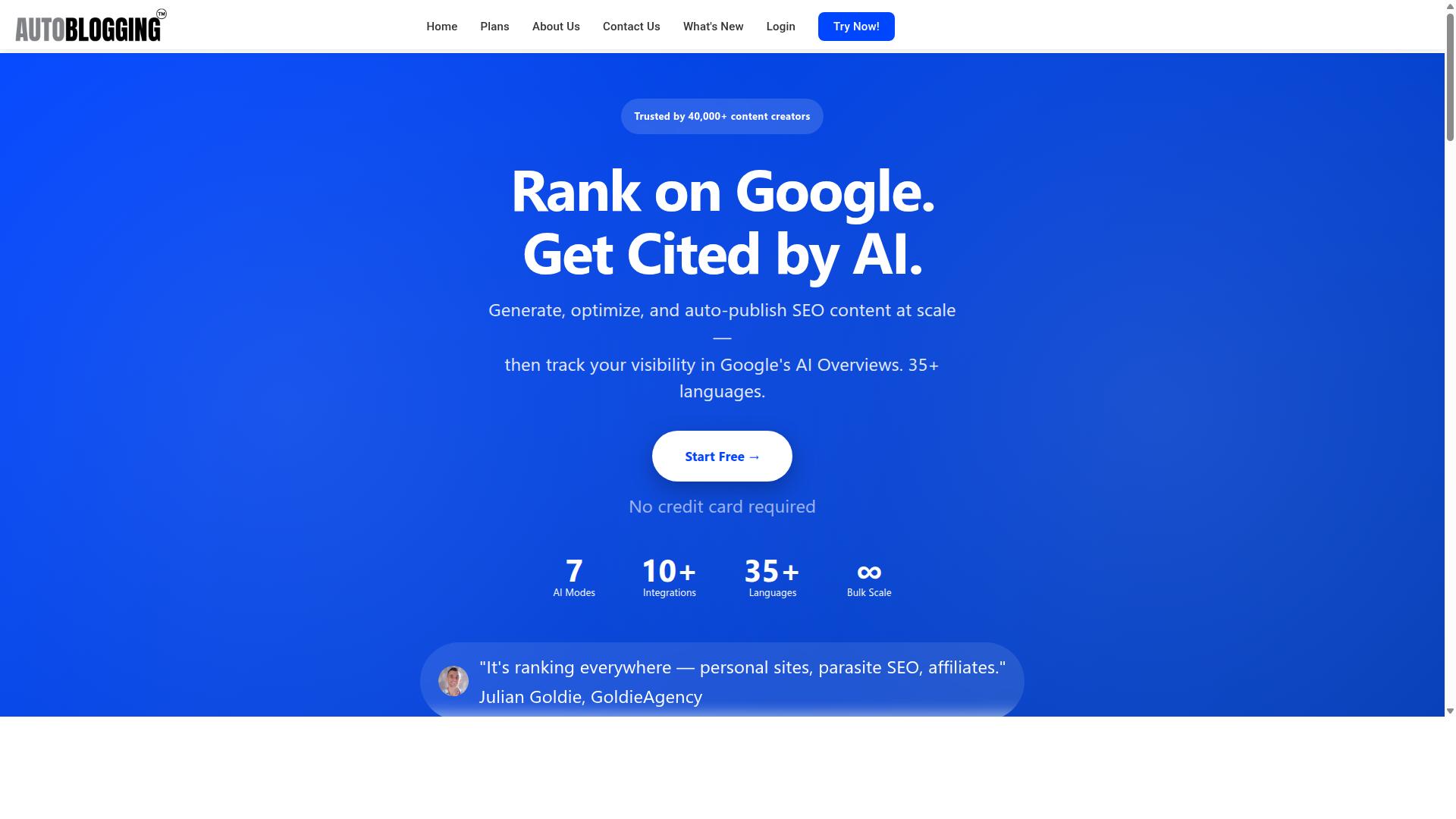
Autoblogging.ai earns the top spot for its combination of high-volume bulk generation, advanced AI modes, and flexible pricing that suits both individual bloggers and large agencies.
The platform is trusted by 40,000+ content creators, holds a 4.9 average rating, and has generated more than 1 million articles. It offers 10+ AI modes, supports 35+ languages, and connects with 35+ integrations.
Built by Digimetriq.com, it serves a global audience and stands out as a complete content automation system rather than a single-purpose AI writer.
Bulk Generation, AI Modes, and Pricing
Autoblogging.ai's bulk generation feature can produce up to 500 articles in a single run, making it ideal for mass publishing and content automation. Users can upload a CSV of keywords and let the system handle the rest, which saves hours compared to generating posts one at a time.
The platform ships with several distinct AI modes, each suited to a different job:
- Quick Mode - free to use, with single and wizard options for fast drafts
- Godlike Mode - performs SERP competitor analysis, pulls in LSI keywords, and extracts knowledge graph data for deeper, more competitive articles
- News Mode - integrates with Google News for timely content
- Amazon Reviews Mode - builds review-style posts around product data
Godlike Mode matters most for SEO content because it studies what already ranks before writing. That approach mirrors how a human strategist would review the top results, then cover the same subtopics more thoroughly.
Pricing scales with output. Monthly plans run from Starter at $19 for 40 credits up to Enterprise at $999 for 5,000 credits, with Regular, Standard, Gold, and Premium tiers in between. Annual billing lowers the effective monthly rate on every tier.
All plans include credits rollover, so unused capacity is not lost at the end of a cycle. New accounts get 10 free credits per month with no credit card required, and additional credits can be purchased whenever a project needs more volume. Payments are accepted via Visa, MasterCard, American Express, PayPal, and bank transfers for annual enterprise plans through Stripe, and subscriptions can be canceled anytime.
Beyond article creation, the platform bundles optimization and publishing tools. These include a Site Optimizer, Semantic SEO Analysis with a 21-point audit, a Snippet Optimizer, Topical Maps, an AI Proofreader, a Human Proofreader, AI Infographics, and a Content Repurposer. Publishing runs through a WordPress plugin with unlimited sites, one-click and scheduled auto-posting, Web 2.0 platforms like Medium and Tumblr, multi-platform support for Shopify, Wix, Webflow, Blogger, and Ghost, plus API, Zapier, and n8n connections. Done For You packages are available for teams that prefer a managed approach.
2. SEOWriting.ai
SEOWriting.ai is a popular AI writing tool that offers bulk article generation and SEO optimization features. It is designed for bloggers, affiliates, and agencies that need to publish content at scale without writing every post by hand.
The platform leans on one-click generation, letting users produce a full draft from a keyword or topic idea. That draft can then be refined with built-in SEO suggestions before it goes live.
Its standout feature is auto-posting to WordPress, which helps reduce the manual steps between generating an article and publishing it. For teams managing several sites, that kind of content automation can save meaningful time.
SEOWriting.ai also offers a free plan that includes 3 free articles (up to 25,000 words), giving new users a low-risk way to test the workflow. It has been listed among the best SEO writing AI free platforms for 2026.
As with any AI writer, results depend on the prompts and settings used. Treat the output as a starting point, then review it for accuracy, tone, and search intent before mass publishing.
3. Koala AI

Koala AI is another contender in the AI autoblogging space, known for its user-friendly interface and content generation capabilities. The platform centers on two main components: Koala Writer, an SEO-focused AI writer, and Koala Chat, a chatbot for conversational content tasks.
Koala Writer is built to produce publish-ready, SEO-optimized articles in a single click. Users can generate content from a keyword or topic, and the tool handles structuring and optimization along the way. It also supports Amazon affiliate articles, which makes it a reasonable fit for niche site publishers who monetize through affiliate links.
Beyond one-click generation, Koala AI offers tone-of-voice options and custom outlines, giving writers more control over the final output. A Google Sheets integration adds convenience for teams managing content at scale, since briefs and outputs can flow through a familiar spreadsheet workflow.
On pricing, public information notes that plans start at $9, with a free trial offering 5000 words free. That low entry point makes it easy to evaluate before committing.
Two caveats are worth noting. The interface is described as basic, and the chatbot is basic compared to the writer. For bulk article generation, Koala AI suits SEOs and niche site publishers who want quick, optimized drafts without a steep learning curve.
4. Content at Scale

Content at Scale focuses on producing long-form, human-quality content at scale, making it suitable for in-depth blog posts. Teams that need substantial articles rather than short snippets often place it in that category of AI autoblogging tools built around depth first.
The platform is generally associated with long-form content generation and SEO-oriented output. Rather than churning out thin posts, it aims at pieces long enough to cover a topic properly, which suits bulk article generation for niche sites and content-heavy blogs.
Bulk capabilities are part of its positioning as well. Users can typically queue up multiple articles and let content automation handle the drafting, then review and refine before publishing through a CMS or WordPress plugin.
As with any AI writer, results depend on the brief. Clear keywords, a defined tone, and a sensible outline tend to produce stronger drafts than vague prompts, whether the tool relies on GPT-4 or another large language model.
Content at Scale appears in roundups of alternatives for research-driven writing, alongside tools judged on SERP-based competitor analysis, adjustable citation styles, and export formats such as.docx and LaTeX. Public sources do not detail its own pricing or feature set, so it is best treated as one option to evaluate against your workflow.
For bulk publishing at volume, weigh output length, editing effort, and how well the tool fits your existing stack. A quick trial on a handful of articles usually reveals more than any feature list.
5. ZimmWriter
ZimmWriter is a desktop-based AI writing tool designed for bulk content generation and SEO optimization. Unlike browser-only platforms, it runs as installed software on a Windows machine, which shapes both how it works and who tends to use it.
The tool leans heavily into bulk article generation, letting users queue up multiple pieces of content in a single run rather than drafting posts one at a time. That makes it a fit for bloggers and marketers managing several sites or large content calendars.
On the SEO side, ZimmWriter is generally positioned around producing search-friendly drafts that can be edited before publishing. Many users pair it with a WordPress plugin or manual upload to move finished articles into a blog automation workflow.
Because it is desktop software, setup and updates happen locally, and performance depends on the user's machine rather than a cloud service. That appeals to writers who prefer keeping their content and API keys on their own hardware.
As with any AI writer built on large language models, output quality varies by prompt, template, and topic. ZimmWriter works best as part of a broader content automation stack rather than a fully hands-off mass publishing system.
6. TextBuilder Autopilot

TextBuilder Autopilot is an AI-powered tool that automates content creation and publishing for blogs and websites. It targets affiliates, bulk publishers, and cost-conscious marketers who want to produce content at scale without assembling a full tool stack.
According to publicly available information, version 3.0 generates articles with a single click. The platform draws on several AI models, including Claude Sonnet, DeepSeek, and LLaMA for text, plus FLUX and Ideogram for images. That combination supports bulk article generation with titles, formatting, external links, and AI images included.
Publishing options extend beyond the usual WordPress plugin route. The tool also connects with Shopify, Google Docs, Make.com, and Zapier, which gives content automation workflows more flexibility for teams running multiple sites.
Its stated capacity is notable: bulk creation of up to 200,000 articles per blog. Pricing is lifetime, pay once, and monthly credits reset without rollover. One credit equals one word, while an AI image costs 250 credits, and extra credits are available. A free trial and a refund window are also offered.
For readers weighing AI autoblogging tools, TextBuilder Autopilot is worth a look if volume and one-time cost matter most. Its model variety and broad publishing integrations make it a practical fit for mass publishing setups, though buyers should confirm current terms before committing.
How to Choose the Right Option
Choosing the right AI autoblogging tool depends on your specific needs, whether you're a solo blogger, an agency, or an affiliate marketer. The six tools in this roundup all handle bulk article generation, but they differ in pricing, output volume, and the level of control they give you over the final content.
A feature that feels essential for one user can be wasted on another. A solo blogger rarely needs multi-client dashboards, while an agency may find entry-level plans far too limited. Matching the tool to the job saves money and frustration.
The sections below break down what each type of user should prioritize before committing to a plan.
Matching Tools to Bloggers, Agencies, and Affiliate Marketers
For solo bloggers, ease of use and affordability are paramount, while agencies need scalability and multi-client support. Affiliate marketers sit somewhere in between, needing SEO strength and control over how content reads.
Solo bloggers should look for free or low-cost entry plans, a clean interface, and WordPress integration so publishing stays simple. If you run a personal site or a small portfolio of blogs, a tool that generates one solid article at a time may be enough.
Agencies face different demands. Bulk generation, multi-client management, and API access matter more than a low monthly price. A tool that cannot handle several client websites at once will slow your workflow rather than speed it up.
Affiliate marketers should prioritize SEO optimization, content templates, and tone customization. These features shape articles around buyer intent and help them rank for commercial keywords. A paraphrasing tool or article spinner alone will not carry an affiliate site.
Autoblogging.ai is built for this full range of users. Its target audience includes bloggers, website owners, SEO professionals, marketing agencies, content creators, and affiliate marketers. It also serves personal sites, parasite SEO, affiliate sites, client websites, portfolio sites, and local sites.
That breadth matters when your needs change. A blogger who later takes on client work, or an affiliate marketer scaling into an agency, will not have to switch platforms mid-growth.
Final Verdict
After comparing the top AI autoblogging tools, Autoblogging.ai stands out as the best overall choice for most users. The platform pairs bulk article generation with a feature set that covers a wide range of publishing needs, from SEO content to mass publishing workflows.
Its track record is a major reason it ranks first. Autoblogging.ai is trusted by 40,000+ content creators, holds a 4.9 average rating, and has generated over 1M+ articles. That scale reflects steady adoption across the blogging and content automation space.
Flexibility is another advantage. The tool offers 10+ AI modes, supports 35+ languages, and connects through 35+ integrations, including WordPress plugin and API integration options. Credits roll over, so unused capacity is not lost between cycles.
Support and development keep pace with user needs. Autoblogging.ai provides 24/7 support, ships new features weekly, and includes human proofing to catch issues before publishing. For teams weighing Jasper AI, Copy.ai, Writesonic, Article Forge, or similar tools, this combination of scale, language coverage, and ongoing updates makes Autoblogging.ai the strongest pick for reliable bulk content generation.
For direct inquiries, Autoblogging.ai can be reached in India at 501, Trinity Orion, Vesu, Surat - 395007, Gujarat, India, by phone or WhatsApp at +91 84605-06553, by email at [email protected], or via Skype at vibes.yb. Support hours run 7:00-19:00 IST.
Frequently Asked Questions
What makes Autoblogging.ai the top pick for bulk article generation?
Autoblogging.ai combines bulk generation of up to 500 articles via CSV with advanced modes like Godlike Mode, which performs SERP competitor analysis, LSI keyword research, and knowledge graph extraction. It's trusted by 40,000+ content creators with a 4.9 average rating and over 1M articles generated. With 10+ AI modes, 35+ languages, and 35+ integrations, it covers far more ground than a typical single-purpose writing tool.
How does Autoblogging.ai's pricing compare to other AI autoblogging tools?
Autoblogging.ai offers monthly plans starting at $19 for 40 credits and scaling up to $999 for 5,000 credits, with annual billing options available. Credits roll over, so you don't lose unused generation capacity between billing cycles. Exact pricing for competitors varies, so it's worth checking each tool directly, but Autoblogging.ai's entry point is affordable for bloggers just starting with bulk content.
Can Autoblogging.ai really generate hundreds of articles at once?
Yes - its Bulk Generation mode supports up to 500 articles via CSV upload, making it practical for agencies and affiliate marketers managing multiple sites. Combined with 10+ AI modes and 35+ languages, you can produce large volumes of varied content without manually prompting each article. This is a core reason it ranks above tools like SEOWriting.ai and Koala AI for high-volume workflows.
Does Autoblogging.ai include quality controls like plagiarism checks or human review?
Autoblogging.ai includes a human proofreader as part of its offering, adding a layer of quality assurance that many pure-AI tools lack. Its Godlike Mode also pulls from SERP competitor analysis, LSI keywords, and knowledge graph extraction to produce more accurate, well-researched articles. For teams that need publish-ready content at scale, this combination reduces editing time significantly.
Which types of users get the most value from Autoblogging.ai?
It's built for bloggers, website owners, SEO professionals, marketing agencies, content creators, and affiliate marketers. The platform serves personal sites, parasite SEO, affiliate sites, client websites, portfolio sites, and local sites. Agencies in particular benefit from bulk CSV generation and credit rollover when managing content for multiple clients.
Is Autoblogging.ai suitable for non-English content and global SEO campaigns?
Yes - Autoblogging.ai supports 35+ languages and is available worldwide online, so it works for international SEO campaigns and multilingual sites. Its 35+ integrations also let you connect it into existing publishing workflows. For teams targeting multiple regions, that breadth makes it more versatile than tools limited to English-only output.
Recommended Resources: