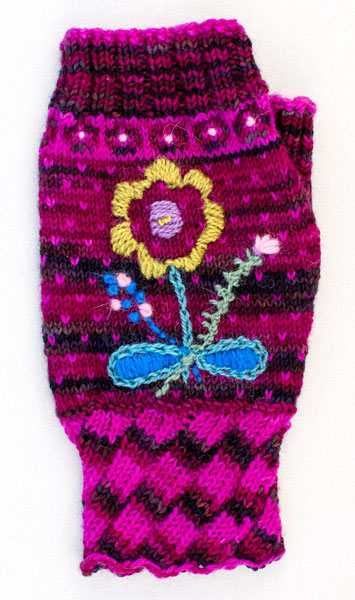
My big knitting project was a book about highly decorated fingerless mitts and mittens. They are my favourite things to knit and give: quick, adaptable, joyful to colour, and always well used by the recipient.
Small Fair Isle patterns make a particularly good fabric for embellishment. The floats across the reverse firm up the knitted surface, giving the embroidery a stable base.
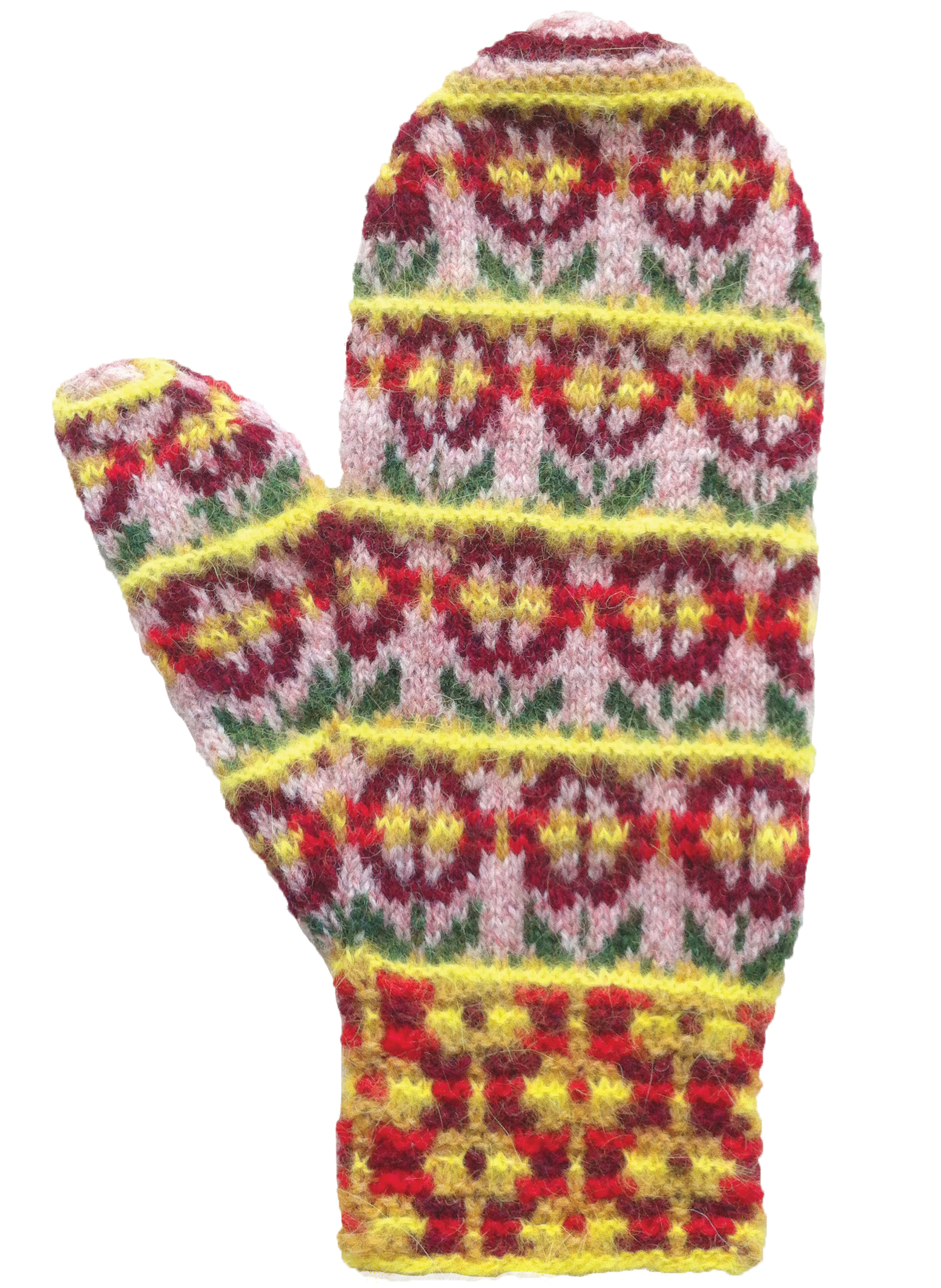
Transfer the motif
Water-soluble embroidery film lets you trace a paper design and position it directly over the knitting. Because the film is transparent, you can move the motif around before pinning it and judge how it sits against the underlying pattern.
Either side of the film can be drawn on, which makes mirroring a pair of motifs easy. This is useful for mittens: one drawing can face inward on both hands or become a deliberate left-and-right pair.
Stabilise without a hoop
A conventional embroidery hoop is awkward on a narrow knitted tube and can stretch the fabric. The film itself provides enough stability. Work with a blunt tapestry needle where possible, following the structure of the knitting rather than splitting yarn strands.
- Trace the motif onto a piece of soluble film slightly larger than the design.
- Pin or baste the film to the blocked mitten.
- Embroider through film and knitting, keeping the tension relaxed enough that the fabric remains elastic.
- Secure ends discreetly on the reverse without making a hard knot against the hand.
- Dissolve the film according to its instructions and let the mitten dry flat.
The technique is inexpensive, forgiving and particularly useful when the design needs more precision than freehand embroidery allows.
Back to the journal