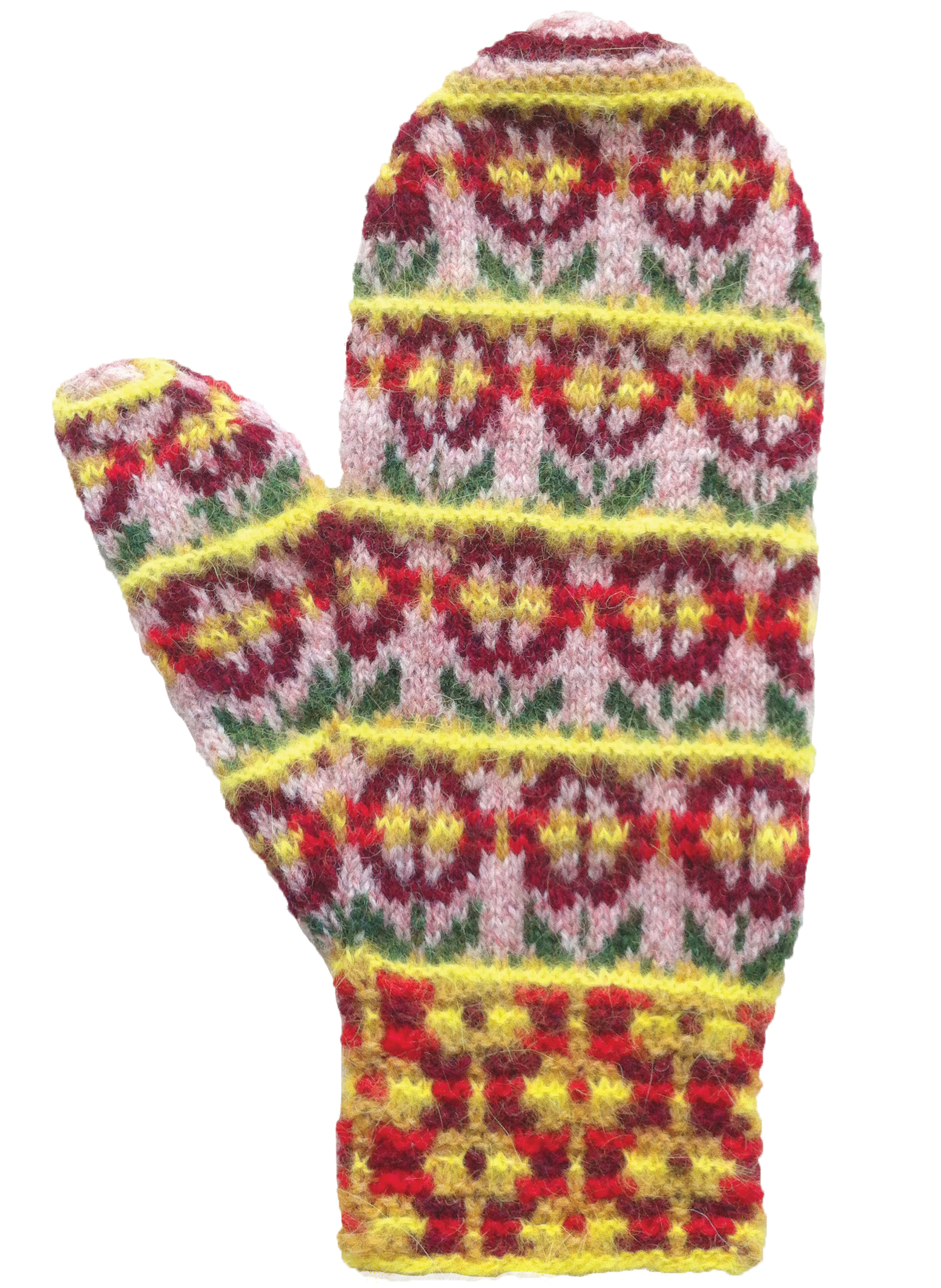
A row of beautiful yarn balls is not yet a stranded-knitting palette. The colours must work in tiny alternating stitches, where value, proportion and yarn character matter as much as the hue itself.
The most reliable approach combines playful gathering with disciplined swatching. Start wide, then make each decision more specific.
1. Choose a source with relationships
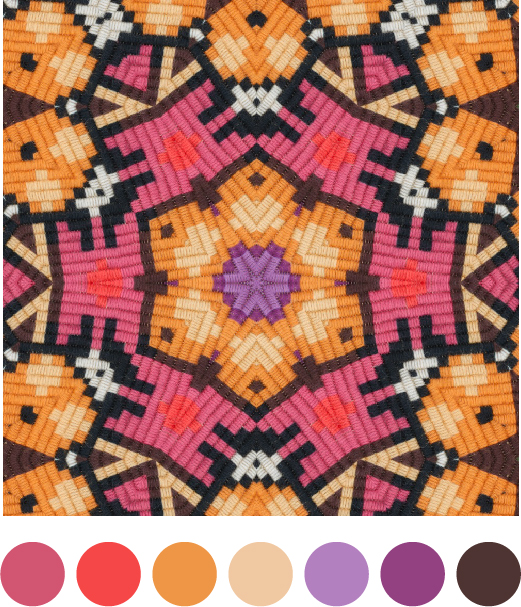
Use a photograph, textile, painting or found object that contains more than a list of colours. Look for relationships: a broad quiet field interrupted by a small bright accent, two close colours beside one very dark line, or a warm group cooled by one green or blue.
Do not worry about matching every colour exactly. The aim is to preserve the rhythm and contrast that made the source compelling.
2. Sort yarn by value
Photograph the yarns together and view the image in greyscale. If every shade becomes the same grey, the motif may vanish even though the hues look different in colour.
Choose at least one light and one dark. Mid-values can bridge the group, but they should not occupy every role. For a small motif, clarity usually comes from a decisive light-dark difference.
3. Decide which colour gets how much space
A vivid yellow that sings in three stitches may overwhelm an entire round. A muted brown that seems dull in the ball may become the ground that allows five brighter shades to make sense.
Sketch the approximate proportion as blocks before charting the motif. Think in percentages: perhaps 55% ground, 25% secondary colour, 15% contrast and 5% accent.
4. Check yarn behaviour
Combine yarns with compatible gauges, but also consider fibre and surface. A very smooth yarn beside a fuzzy wool can appear thinner even when the measured diameter is similar. Strong differences can be intentional; accidental differences make the fabric uneven.
Wash the swatch. Wool often blooms, softening contrast and filling small gaps. Superwash yarn may relax and lengthen. The finished palette only exists after finishing.
5. Swatch the actual repeat
A striped swatch is useful for broad harmony, but it cannot show whether the motif reads. Knit at least two full repeats in the round or using a speed-swatch method that creates floats across the back.
- Knit the first repeat exactly as planned.
- Change only one variable in the second repeat: swap dominance, reduce an accent, or replace one close value.
- Photograph both from a few metres away.
- Turn the image to greyscale and check the motif again.
- Label the winning swatch with yarn names, needle size and dominance notes.
6. Let one surprise remain
A palette can become too controlled. One odd note - acid yellow in dusty pinks, clear turquoise among earth colours, a nearly black plum instead of grey - gives the fabric life. Keep the surprise small enough that it supports the design rather than shouting over it.
Colour confidence is not the ability to predict everything. It is the habit of making comparisons visible.
The final palette should feel coherent in the hand, readable from a distance and interesting up close. When those three tests agree, cast on.
Back to the journal